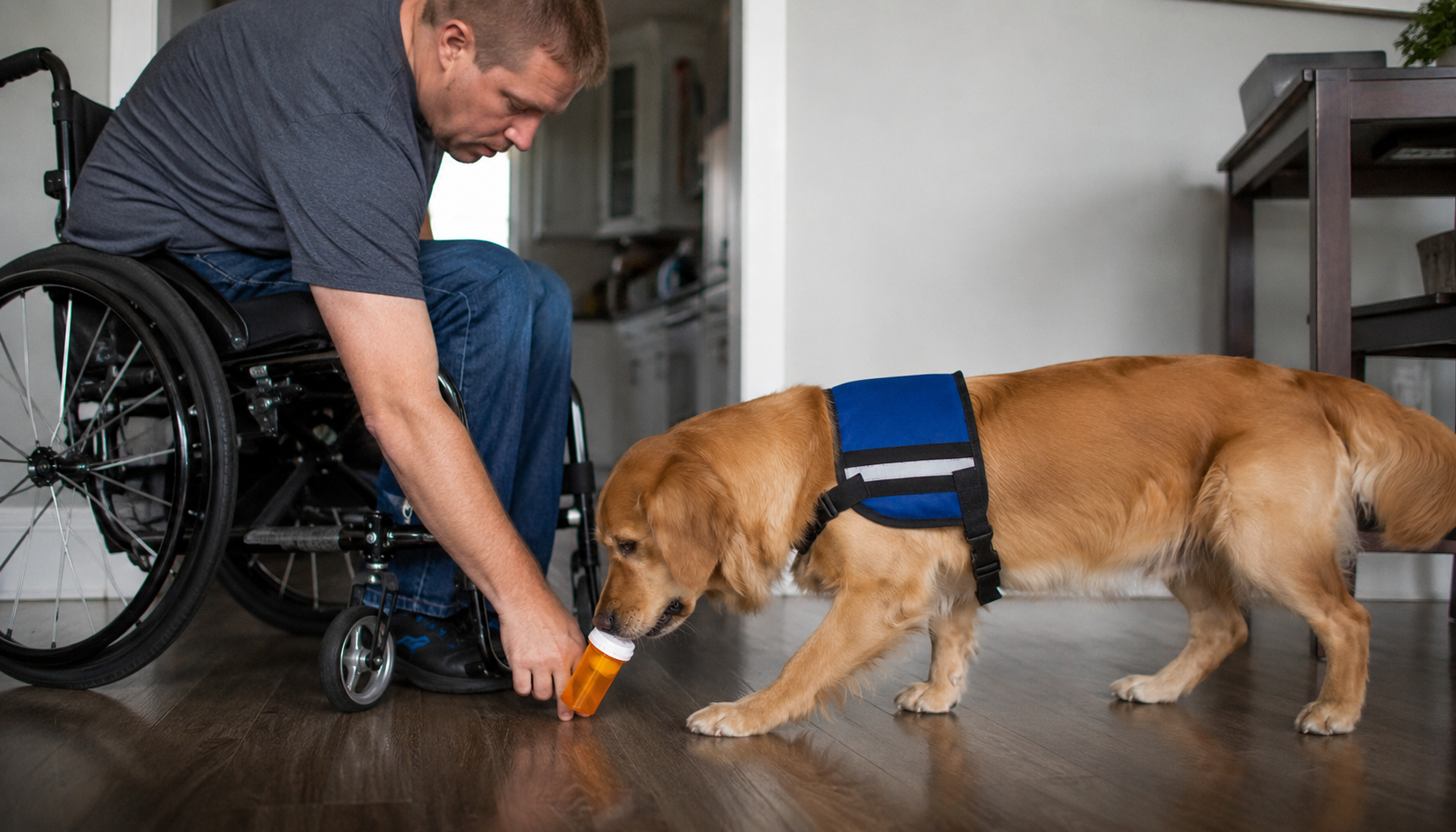
Service Dog Tasks: What "Trained to Perform a Task" Means
A task is a specific trained action that mitigates a disability, and it is the legal heart of the ADA definition. See real task examples by disability type, and why comfort alone is different.
Why tasks are the legal heart of the definition
The Americans with Disabilities Act (ADA) defines a service animal as a dog that is individually trained to do work or perform tasks for a person with a disability. The phrase "trained to perform a task" is the part that does all the heavy lifting. Without a trained task, a dog simply does not meet the definition, no matter how loved or well behaved it is.
A task is a specific, deliberate action the dog has been taught to do that directly helps with the handler's disability. It is something the dog does, on cue or in response to a situation, not just something the dog is. That distinction is the whole game.
A trained task versus comfort or presence
Here is the line the ADA draws clearly: a trained action qualifies, but presence alone does not. A dog that makes its owner feel calmer simply by existing nearby is providing comfort, and comfort is real and valuable. But comfort from presence is not a trained task, so on its own it does not make a dog a service dog.
This is precisely why emotional support animals (ESAs) are a different category. An ESA helps through companionship and presence, not through a specific trained action, so it does not have ADA public access rights. For a side-by-side breakdown, see service dog vs ESA vs therapy dog, and for the underlying definition, what is a service dog.
The test is simple to state: what does the dog do? If the honest answer is "it is just there for me," that is comfort. If the answer is "it is trained to do X when Y happens," that is a task.
Concrete task examples by disability type
Tasks look different depending on what they are meant to mitigate. The examples below are realistic and general, not an exhaustive list. Many dogs are trained for several tasks at once.
Mobility tasks
- Bracing or counterbalancing to help a handler stand or stay steady
- Retrieving dropped items, such as keys, a phone, or a cane
- Opening and closing doors, drawers, or cabinets
- Pulling a wheelchair or carrying small items
Guide work (vision)
- Guiding a handler who is blind or has low vision around obstacles
- Stopping at curbs, stairs, and changes in elevation
- Finding doors, seats, or a clear path on cue
Hearing alerts (sound)
- Alerting a deaf or hard of hearing handler to a doorbell, alarm, or name being called
- Leading the handler toward the source of an important sound
Medical alert and response
- Alerting to a drop or spike in blood sugar for a diabetic handler
- Responding to a seizure, such as staying with the handler or seeking help
- Fetching medication or a phone during a medical event
Psychiatric tasks
Psychiatric service dogs perform trained tasks just like any other service dog. Common examples include:
- Interrupting harmful or repetitive behaviors, such as nudging to break a freeze or self-harm pattern
- Applying deep pressure to help calm a handler during a panic attack or flashback
- Searching a room or turning on lights to ease anxiety on entering a space
- Guiding a disoriented handler to a safe place or exit
- Reminding a handler to take medication at a set time
If this is your situation, our deeper guide on psychiatric service dogs for anxiety and PTSD walks through how these tasks are trained and used.
A task does not have to look dramatic
People sometimes assume a "real" task has to be visible and impressive, like a guide dog crossing a busy street. That is not the standard. A dog trained to press its body against its handler when it senses rising distress is performing a task just as legitimately. What matters is that the action is trained and tied to the disability, not how it looks to a bystander.
What this means for access
Because the task is the qualifier, businesses are limited in what they can ask. Staff may ask only whether the dog is required because of a disability and what work or task it has been trained to perform. They may not ask about your diagnosis or demand paperwork. We cover this in the two questions businesses can legally ask.
Where an ID card fits in
Training is what makes a service dog. No registration, certificate, ID card, or vest creates the status, and none is required by law. The ADA does not recognize any national registry, and we are not affiliated with the government, the Department of Justice, or the ADA in any way.
Some handlers still like carrying an ID card as a convenience, because it can make answering the two questions feel quicker and less confrontational. That is the only thing it does. If you want that kind of optional tool, you can see our voluntary ID card plans, knowing it grants no rights and is never mandatory.
Written and reviewed by the ADA Service Dog Team
VerifiedADA Service Dog is operated by NS Design ID Cards, the team behind assistancedogregistry.co.uk and esasupport.co.uk, supporting assistance dog handlers since 2020 with over 20,000 ID cards shipped. Our guidance is grounded in the Americans with Disabilities Act and current Department of Justice, DOT, and HUD guidance. Registration is voluntary, and we always say so honestly.
Important
This article is general orientation, not legal advice. For your specific situation, contact the ADA Information Line at 1-800-514-0301 or a disability rights attorney. ADA Service Dog Registry is a voluntary handler identification platform, not affiliated with the ADA, DOJ, or any US government agency.
Keep reading

Service Dog Requirements in 2026: What the ADA Actually Requires
The ADA has one real service dog requirement: a handler with a disability and a dog trained to do a task. No c...
Read →
What Is a Service Dog? The ADA Definition in Plain English
A service dog is a dog individually trained to do work or tasks for a person with a disability. Training makes...
Read →
How to Get a Service Dog: The Real Paths and What Each Involves
Four honest ways to get a service dog: an accredited program, a hired trainer, owner-training, or choosing the...
Read →Get the card. Skip the explanations.
Digital handler ID + AI ADA Coach + state-specific rules from $4.99/mo. 30-day money-back guarantee on lifetime plans.
See plans →