How to Get a Service Dog: The Real Paths and What Each Involves
Four honest ways to get a service dog: an accredited program, a hired trainer, owner-training, or choosing the right candidate dog. What makes it legal is task training, never paperwork.
First, what "getting a service dog" actually means
Under the Americans with Disabilities Act (ADA), a service dog is a dog that is individually trained to do work or perform tasks directly related to a person's disability. That training is the whole thing. A dog is not a service dog because it has paperwork, a vest, or an entry in some database. It is a service dog because it reliably does disability-related tasks.
So "how to get a service dog" is really a question about how to end up with a trained dog. There are several genuine paths, and the right one depends on your time, your budget, your disability, and the kind of tasks you need. If you are still sorting out the basics, our guide on what a service dog is is a good starting point.
Path 1: A dog from an accredited program
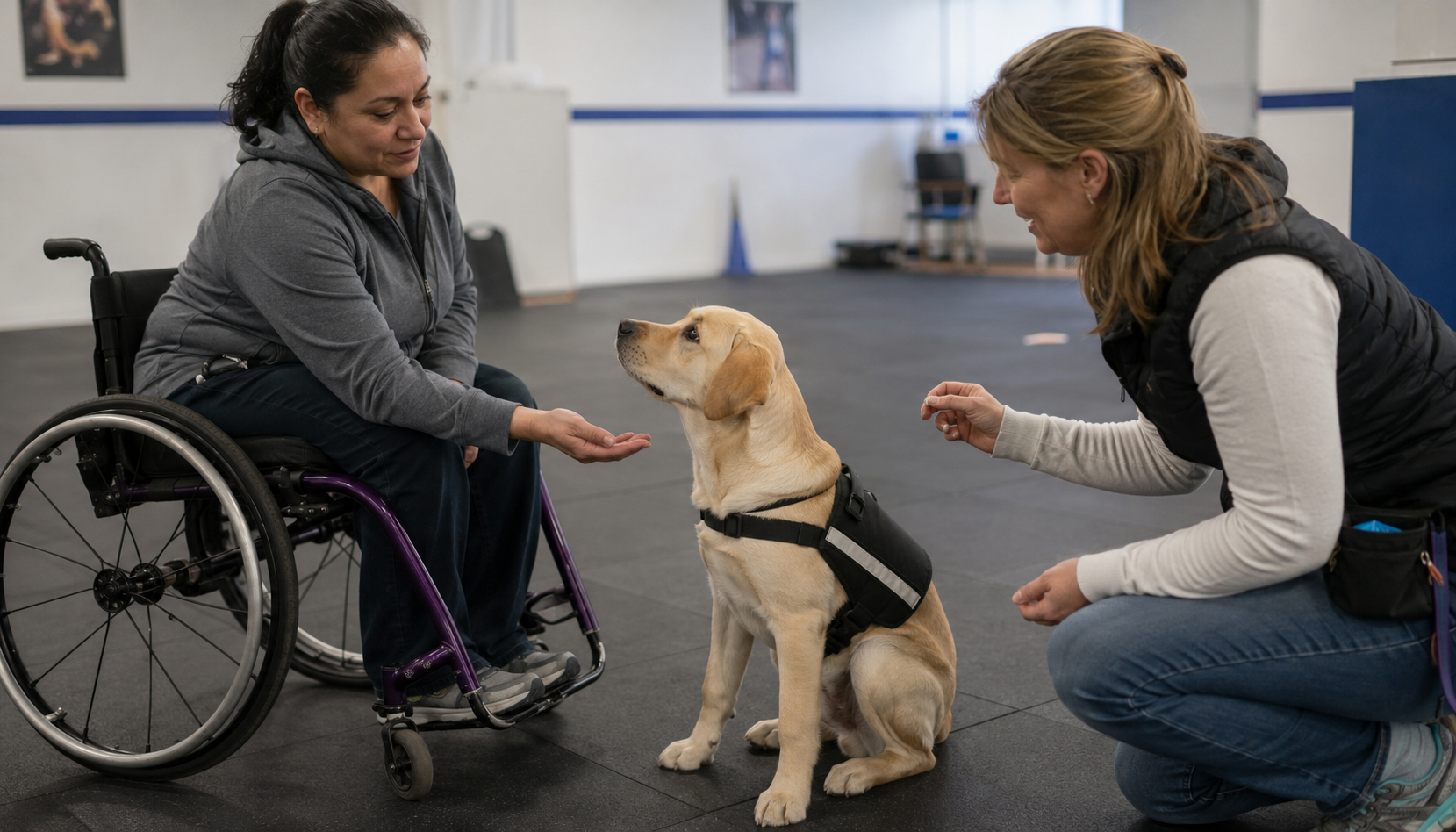
Many people get their service dog from a nonprofit organization that breeds, raises, and trains dogs, then matches them with handlers. This is often the gold standard for reliability, because the dog arrives already trained to a high level.
The honest tradeoffs:
- Long waits. Demand far outstrips supply. Waitlists are often measured in years, not months.
- An application process. Programs usually ask for documentation of your disability and an interview, and they assess whether a dog is a good fit for your situation.
- Cost varies widely. Some programs provide dogs at low cost or free through donations and grants, especially for certain disabilities or populations. Others charge significant fees. Ask each program directly rather than assuming.
- Less say in the dog. The program usually chooses the dog and the tasks it is trained for.
If a fully trained dog and a structured match matter more to you than speed or control, a program is worth pursuing, even with the wait.
Path 2: Hire a professional trainer for your own dog
If you already have a suitable dog, or want to choose your own, you can hire a professional service dog trainer to do the task training. This sits in the middle: more control and often a shorter timeline than a program waitlist, but real cost and effort on your part.
What this usually involves:
- An honest temperament assessment of your dog before any money changes hands.
- A training plan built around your specific disability-related tasks.
- Months of work, often with you participating in sessions so the dog responds to you.
- Ongoing costs that add up over time, which vary a lot by trainer and region.
A good trainer will tell you plainly if your dog is not a candidate. Be wary of anyone who promises a guaranteed service dog quickly or sells "certification" as part of the package.
Path 3: Owner-train your own dog
The ADA explicitly allows you to train your own service dog. You do not need a program, a credential, or professional help to do it legally. Owner-training gives you the most control and usually the lowest direct cost, but it asks the most of you in time and consistency.
Realistically, owner-training takes many months to a couple of years of steady, almost daily work: foundation obedience, then task training, then proofing those tasks in every kind of public setting. Most people who quit do so early, when it feels slow. If you want a detailed, real-world walkthrough, read our story on training your own service dog.
The hard truth: owner-training is the right path for some people and the wrong path for others. Be honest with yourself about how much time and patience you can commit before you start.
Path 4: Choosing the right candidate dog
Whether you hire a trainer or train the dog yourself, it all rests on the dog. Most dogs, including many wonderful pets, are not suited to service work. Selecting well is the single biggest factor in whether you succeed.
Look for a dog that is:
- Calm and stable in new, busy, and unfamiliar places.
- Not reactive to strangers, noises, or other dogs.
- Healthy, with sound joints and good general health for a long working life.
- The right size for the tasks you need, especially for any bracing or mobility work.
- Eager to work with you rather than fiercely independent.
You can find a candidate from a responsible breeder or from a shelter or rescue. Adoption can absolutely work, but it raises the odds of an unknown history, so a careful temperament assessment matters even more.
What does NOT make a service dog
This is where a lot of people get misled. Buying a vest, an ID card, or a spot in an online "registry" does not turn a dog into a service dog and grants no legal rights at all. Registration of service dogs is voluntary and not required, and no registry is official or run by the government. We are an independent company, not affiliated with the Department of Justice, the ADA, or any government agency.
Businesses are limited to two questions, and paperwork is not one of them. See what actually qualifies a dog as a service animal, and if you are weighing options, our comparison of a service dog, emotional support animal, and therapy dog may help, since the right path differs for each.
Common questions
What are the ways to get a service dog?
There are four main paths: apply to an accredited service dog program, hire a professional trainer to train a dog for you, train your own dog (owner-training, which the ADA permits), or select a suitable candidate dog and train it with help. What makes the dog a service dog is task training, not where it came from.
How much does a service dog cost?
Program-trained service dogs typically cost between $15,000 and $50,000, though many nonprofits place them at reduced or no cost. Owner-training is far cheaper but requires significant time and skill. Cost has no bearing on legal status; an owner-trained dog has the same ADA rights as a program dog.
Can I train my own service dog legally?
Yes. The ADA explicitly allows people with disabilities to train their own service dogs. There is no requirement to use a professional trainer or accredited program. The dog must still be trained to perform a task and behave appropriately in public.
How long does it take to get a service dog?
An accredited program can have a waitlist of one to three years. Owner-training a task-reliable service dog typically takes 12 to 24 months of consistent work. Timelines vary widely based on the dog, the tasks, and the training approach.
Key terms explained
- Accredited program
- An organization that breeds, raises, and trains service dogs and places them with handlers, often following industry standards.
- Owner-training
- Training your own service dog yourself, which is legal under the ADA.
- Candidate dog
- A dog selected for the temperament and health needed to become a working service dog.
- Washout
- A dog that does not complete service training because it lacks the temperament or health for the work.
Written and reviewed by the ADA Service Dog Team
VerifiedADA Service Dog is operated by NS Design ID Cards, the team behind assistancedogregistry.co.uk and esasupport.co.uk, supporting assistance dog handlers since 2020 with over 20,000 ID cards shipped. Our guidance is grounded in the Americans with Disabilities Act and current Department of Justice, DOT, and HUD guidance. Registration is voluntary, and we always say so honestly.
Important
This article is general orientation, not legal advice. For your specific situation, contact the ADA Information Line at 1-800-514-0301 or a disability rights attorney. ADA Service Dog Registry is a voluntary handler identification platform, not affiliated with the ADA, DOJ, or any US government agency.
Keep reading
Service Dog Requirements in 2026: What the ADA Actually Requires
The ADA has one real service dog requirement: a handler with a disability and a dog trained to do a task. No c...
Read →
What Is a Service Dog? The ADA Definition in Plain English
A service dog is a dog individually trained to do work or tasks for a person with a disability. Training makes...
Read →
How to Make Your Dog a Service Dog: The Honest, Legal Answer
You do not make a service dog by registering it, buying a vest, or getting a certificate. You make one through...
Read →Get the card. Skip the explanations.
Digital handler ID + AI ADA Coach + state-specific rules from $4.99/mo. 30-day money-back guarantee on lifetime plans.
See plans →