What Can a Landlord Legally Ask About Your Service Dog? (2026 HUD Update)
HUD withdrew its long-standing assistance animal guidance in September 2025, and a May 2026 enforcement memo now centers on trained task work. Here is exactly what a landlord may ask, what they may never ask, and how the new rules affect ESAs.
First, which law applies in housing
Inside your home and your application for one, the ADA mostly steps aside and the Fair Housing Act (FHA) takes over. The FHA requires housing providers to grant reasonable accommodations to rules and policies (like a no-pets policy) when needed for a person with a disability to use and enjoy the home. That statute has not changed.
What changed is the guidance built on top of it. For over a decade, landlords and tenants both worked from HUD's assistance-animal notices, FHEO-2013-01 and FHEO-2020-01 (the famous "Assistance Animals Notice" that made ESA letters near-automatic). HUD withdrew both notices on September 17, 2025. Then, on May 22, 2026, HUD's Office of Fair Housing and Equal Opportunity issued an enforcement memorandum permanently cancelling them and instructing staff to find reasonable cause on animal accommodation complaints only where the animal is individually trained to do work or perform tasks for the person with a disability. Comfort or companionship alone no longer supports a federal HUD complaint.
If you have a task-trained service dog, this shift works in your favor: the standard HUD now enforces is the standard your dog already meets. If you have an ESA, the federal enforcement route has narrowed sharply, though state law and private lawsuits remain (more below).
Scenario 1: Disability and need are obvious
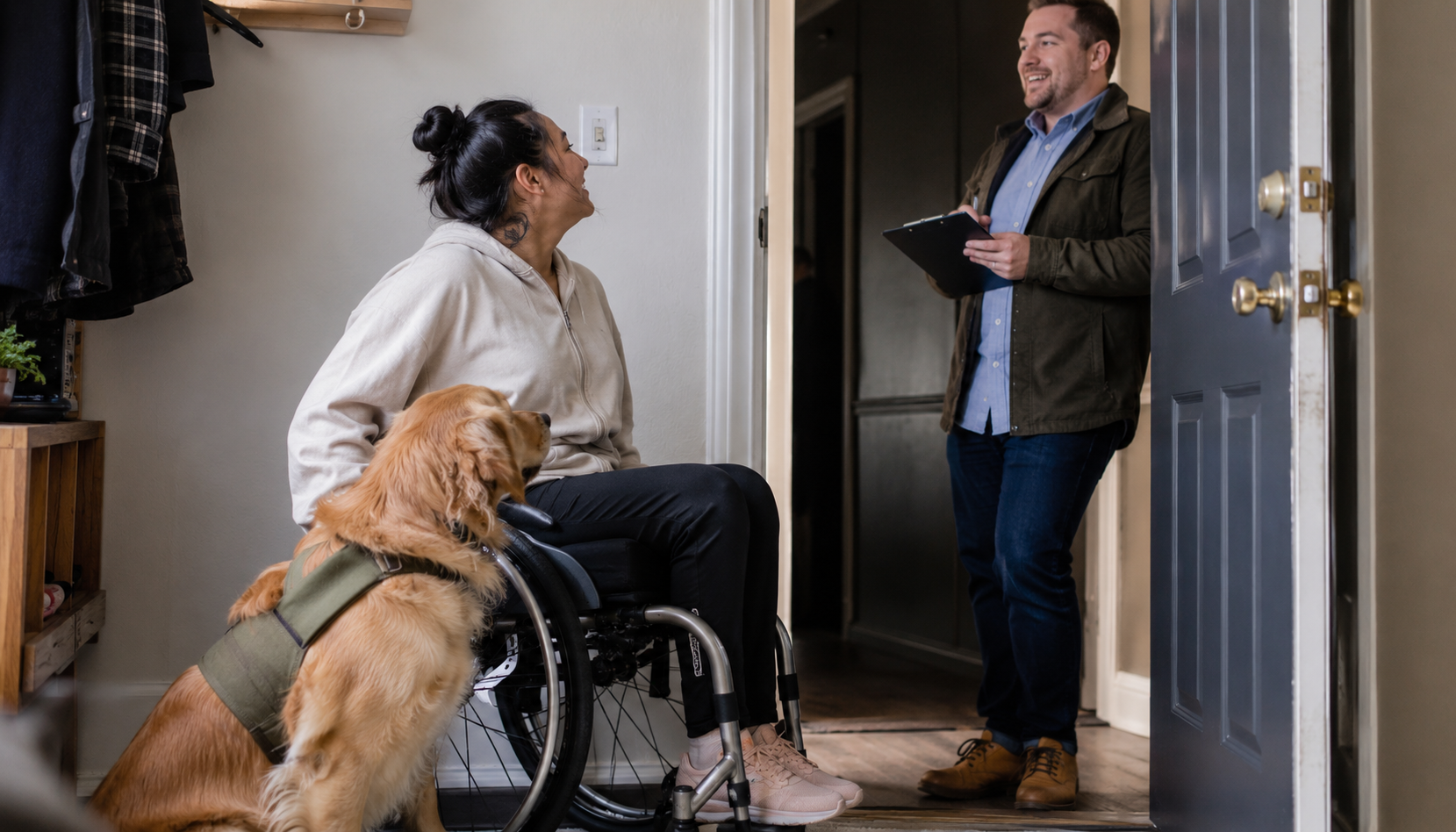
A guide dog in harness with a blind tenant, a mobility dog braced beside a wheelchair user. When both the disability and the dog's work are apparent, the landlord may not ask for documentation of either. They can ask the practical questions any landlord asks about any animal living in a unit: the dog's name, age, vaccination status as required by local animal-control law. They cannot ask about your condition or demand proof of training.
Scenario 2: Disability or need is not obvious
This covers most psychiatric service dogs, seizure alert dogs, cardiac alert dogs, and so on. Here the landlord may request reliable information establishing two things:
- That you have a disability (a physical or mental impairment substantially limiting a major life activity), and
- That the dog does disability-related work or tasks for you.
"Reliable information" can be a letter from a treating doctor, therapist, or other professional with actual knowledge of your situation, or in many cases your own credible statement describing the trained tasks. After the 2026 memo, expect landlords to focus hard on the second element: what is the dog trained to do? Be ready to answer specifically. "She is trained to interrupt panic attacks by deep pressure and to retrieve my medication" is the kind of answer that fits the current federal standard. "She comforts me" is, under the May 2026 memo, no longer something HUD will enforce on its own.
What a landlord can NEVER ask
- Your diagnosis. They may ask whether you have a disability-related need, not what the disability is.
- Your medical records, or that your doctor fill out the landlord's own intrusive form.
- "Registration," "certification," or an ID card. No registry has ever been a lawful requirement in housing, before or after the HUD changes. We sell voluntary ID and we will say it plainly: a landlord cannot require it, and it proves nothing by itself. Our guide on whether service dogs must be registered covers this in depth.
- A task demonstration. Same rule as in public under the ADA, where businesses get only two questions.
- A pet deposit, pet rent, or pet fee as a condition of granting the accommodation. An assistance animal is not a pet. Fees and breed rules get their own full treatment in our FHA renting guide.
What the landlord CAN still do
Honesty cuts both ways, so here is the landlord's side of the line:
- Ask the two-part question above when things are not obvious, and take a reasonable time to evaluate (though stalling for months is itself a denial tactic).
- Deny a specific animal that is a direct threat based on its actual conduct (bite history, aggression), not breed or size stereotypes.
- Charge you for actual damage the dog causes, exactly as they would charge any tenant for damage.
- Expect the dog to be under control and local licensing and vaccination law to be followed.
- Decline accommodations for buildings genuinely outside the FHA, such as some owner-occupied buildings with four or fewer units and single-family homes rented without an agent.
The ESA question, honestly
Through 2024, the practical answer to "can my landlord refuse my ESA letter?" was usually no, citing FHEO-2020-01. That citation is dead. The current honest picture for ESA owners:
- The FHA statute itself still exists unchanged, and courts, not HUD memos, have the final word on what "assistance animal" means. Private FHA lawsuits remain possible.
- HUD will not pursue your complaint if your animal's role is comfort alone. That federal enforcement lever, which did most of the work for a decade, is gone for now.
- State and local law may still protect you. California, New York, and Washington, among others, have their own assistance-animal housing rules that include emotional support animals. Check your state in our 50-state rules guide, and see the New York housing guide for one strong example.
- The memo is contested. Disability rights organizations dispute its legality, and an enforcement memo can be revised by a future administration. This is the law's posture as of June 2026, not necessarily forever.
If your dog is trained to perform tasks for a psychiatric disability, it is a service dog, not an ESA, and the new landscape favors you. If you are unsure which side of the line your dog is on, our service dog vs ESA vs therapy dog breakdown is the place to start.
A script for the conversation
"I have a disability and my dog is individually trained to perform tasks related to it. I'm requesting a reasonable accommodation to your pet policy under the Fair Housing Act. I'm happy to provide reliable documentation of my disability-related need. I can't share my diagnosis or medical records, and the law doesn't require registration or certification documents, which don't exist in any official form."
Put the request in writing (email is fine), keep every reply, and stay factual. If you are denied or stonewalled, you can file with HUD at hud.gov/fairhousing (keeping in mind the trained-task standard now applied), with your state's fair housing agency, which may apply broader state law, or consult a fair-housing attorney about a private FHA claim.
One soft note from us: handlers tell us that having their dog's trained tasks written out clearly, on a card or a verification page they can pull up during a landlord meeting, keeps these conversations short. That is a convenience we sell from $4.99 a month, never a requirement, and nothing a landlord can lawfully demand. Your rights are in the statute, and they were never for sale.
Written and reviewed by the ADA Service Dog Team
VerifiedADA Service Dog is operated by NS Design ID Cards, the team behind assistancedogregistry.co.uk and esasupport.co.uk, supporting assistance dog handlers since 2020 with over 20,000 ID cards shipped. Our guidance is grounded in the Americans with Disabilities Act and current Department of Justice, DOT, and HUD guidance. Registration is voluntary, and we always say so honestly.
Important
This article is general orientation, not legal advice. For your specific situation, contact the ADA Information Line at 1-800-514-0301 or a disability rights attorney. ADA Service Dog Registry is a voluntary handler identification platform, not affiliated with the ADA, DOJ, or any US government agency.
Keep reading
Do Service Dogs Have to Be Registered? No. Here's What That Means for You
There is no federal service dog registry, no state requires one for ADA access, and no business can demand pap...
Read →
Service Dogs and Renting: Pet Fees, Breed Bans, and No-Pet Buildings (2026 FHA Guide)
No pet deposit, no pet rent, no breed restrictions: under the Fair Housing Act a service dog is not a pet. A p...
Read →
The Only 2 Questions a Business Can Legally Ask You Under the ADA
The Americans with Disabilities Act lets a restaurant, hotel, or store ask exactly two things — and prohibits...
Read →Get the card. Skip the explanations.
Digital handler ID + AI ADA Coach + state-specific rules from $4.99/mo. 30-day money-back guarantee on lifetime plans.
See plans →