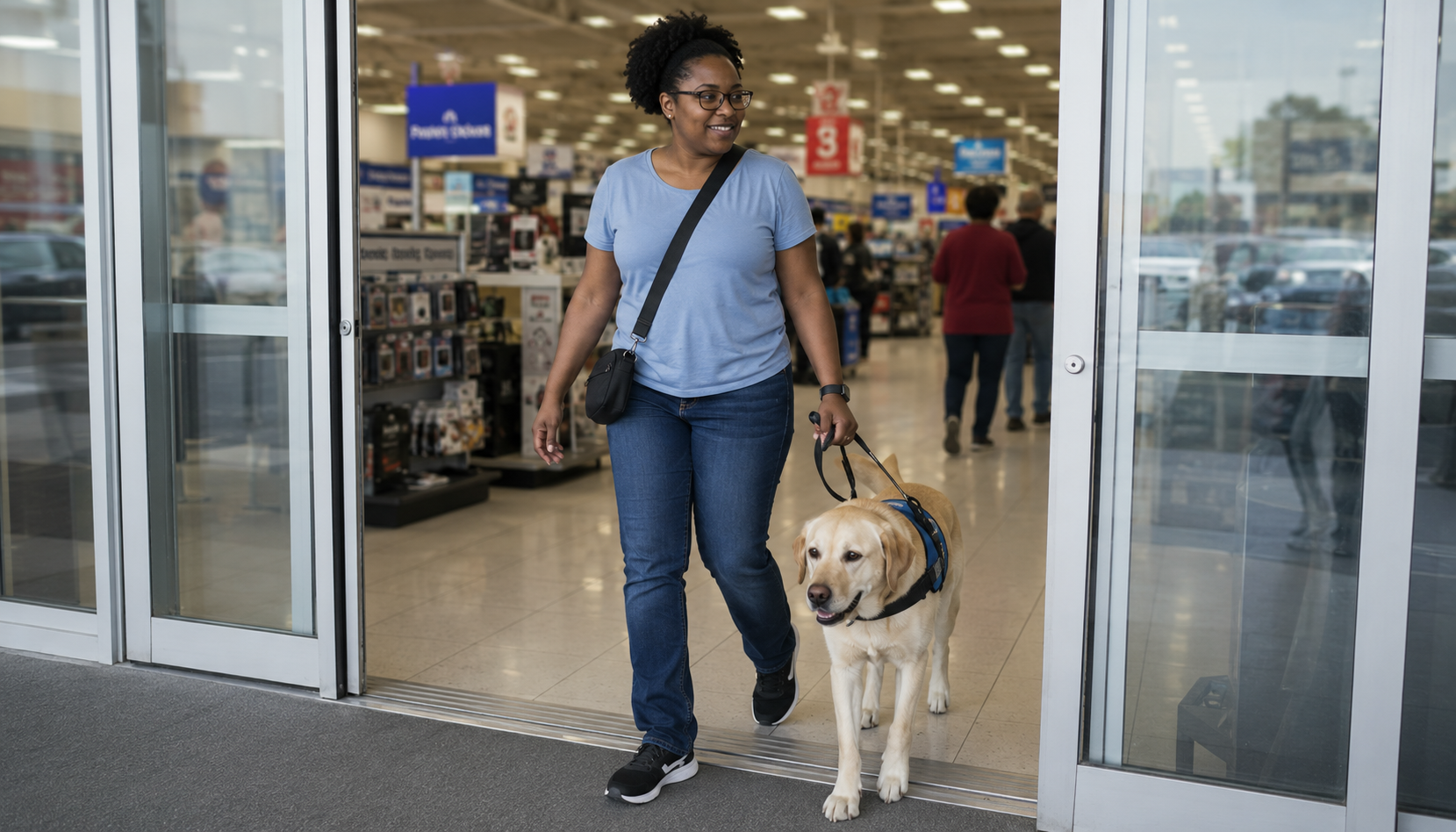
Do Service Dogs Have to Be Registered? No. Here's What That Means for You
There is no federal service dog registry, no state requires one for ADA access, and no business can demand papers. An ID seller explains, honestly, why registration is voluntary, what the DOJ actually says, and when a card is still worth having.
The straight answer
Under the Americans with Disabilities Act, a service animal is a dog that has been individually trained to do work or perform tasks for a person with a disability. That is the entire legal test. The Department of Justice says it directly in its ADA service animal FAQ on ada.gov: covered entities "may not require documentation, such as proof that the animal has been certified, trained, or licensed as a service animal, as a condition for entry."
So when someone asks "do service dogs have to be registered?", the honest answer has three parts:
- No registration is required. Not federally, not as a condition of public access in any state.
- No registration grants rights. A registry listing, ID card, vest, or certificate does not make a dog a service animal. Training does.
- No business can ask for it. Staff are limited to two questions: is the dog required because of a disability, and what work or task is it trained to perform.
Why does Google say otherwise?
Search "service dog registration" and you will find dozens of sites selling "official certification" with seals, badges, and language designed to look governmental. The DOJ has addressed this head-on. From the ADA FAQ:
"There are individuals and organizations that sell service animal certification or registration documents online. These documents do not convey any rights under the ADA and the Department of Justice does not recognize them as proof that the dog is a service animal."
That is the federal government describing an entire industry, and yes, we operate in the same industry. The difference we try to hold ourselves to is in the framing: a registry listing is a convenience product, like a luggage tag or a medical alert bracelet. It is not a license, it is not certification, and anyone who tells you it is "legally required" is lying to sell you something.
The paperwork that does exist
People often confuse three real documents with a registration requirement. None of them is a registry, but they are worth knowing:
- The DOT Service Animal Air Transportation Form. Airlines may require this self-attestation form, generally up to 48 hours before departure, under the Air Carrier Access Act rules in force since 2021. It is the only federally sanctioned service dog form, and it is free. We walk through every field in our DOT form guide.
- Housing accommodation requests. Under the Fair Housing Act, a landlord may ask for reliable information about a disability-related need when the disability is not obvious. This area changed significantly in 2025 and 2026; our landlord questions guide covers the current rules.
- Voluntary state tag programs. A few states, such as Florida and California, offer free official tags through county offices. These are optional too, and we cover them in our Florida tag guide.
Notice what is missing from that list: any kind of national service dog registry. It does not exist. The federal government has never created one and has repeatedly said it does not recognize private ones.
What about "certification" from a trainer?
Legitimate programs like Assistance Dogs International member organizations do test and graduate dogs, and that paperwork can be genuinely useful as evidence of training. But the ADA explicitly allows owner training, with no program, test, or graduation certificate required. One of our contributors trained her own mobility dog over 18 months with zero paperwork, and that dog has exactly the same legal status as a $40,000 program dog.
If you are sorting out where your dog falls legally, start with our guide to service dogs vs ESAs vs therapy dogs. The training-based distinction matters more in 2026 than ever, because federal housing enforcement now turns on it.
So why would anyone register a service dog?
Fair question, especially coming from a company that sells registration. Here is the honest version.
The law is on your side, but the person at the door usually has not read it. Hosts, gate agents, hotel clerks, and security guards challenge handlers every day with questions they are not allowed to ask. You can recite the law every time, and you have every right to. Many handlers do exactly that and never spend a dollar on ID. Others find that handing over a card with the dog's photo, the two ADA questions printed on it, and a scannable verification link ends the conversation in ten seconds instead of ten minutes.
That is the entire value proposition: friction reduction. Not rights. Not legality. Convenience and a shortcut through other people's ignorance. An autistic handler wrote about what that shortcut meant for her, and her reasoning is the best case for voluntary ID we know of, precisely because it never pretends the card is required.
"But the store asked for my registration." What now?
Knowing registration is voluntary does not stop untrained staff from demanding it. When it happens, stay calm and give them the law in one breath:
"There's no such thing as official service dog registration. Under the ADA you can ask me two questions: whether the dog is required because of a disability, and what task he's trained to perform. He's trained to [task]. Happy to continue shopping now."
If they hold firm, ask for a manager, and if that fails, the ADA Information Line (1-800-514-0301) and the DOJ complaint portal at ada.gov are your escalation path. We wrote a full step-by-step in what to do when a business refuses your service dog. The key mindset: their mistaken belief in a registry does not create an obligation for you, and producing a card you happen to own is a choice, never a concession that one was required.
One warning about the reverse situation: never let a fake "registration certificate" tempt you into passing off a pet. Most states now penalize service animal misrepresentation, and the penalties are climbing. Texas raised its fine to up to $1,000 plus community service effective September 2023, and California treats fraud as a misdemeanor with up to a $1,000 fine and jail time. The paper that supposedly "registers" a pet as a service dog is worthless as a defense, because the law looks at training, not paperwork.
Red flags that a registry is misleading you
- It says registration is "required by law" or "ADA mandated." False, always.
- It claims its certificate guarantees access to housing, flights, or businesses. No document can.
- It uses government-style seals or implies affiliation with the ADA or DOJ. The ADA is a law, not an agency that licenses anyone.
- It will register any animal, sight unseen, as a "certified service animal" with no questions about training or tasks.
- It charges for an "ESA letter" plus "service dog certification" bundle. These are different legal categories, and bundling them is a tell.
Know the actual source of your rights
Your rights come from the ADA, the Fair Housing Act, and the Air Carrier Access Act, full stop. They attach to the team you and your dog have become through training, not to anything you can buy. Read the primary source at ada.gov/topics/service-animals, then see our plain-English summary on the Your ADA Rights page and the state-level additions in our 50-state rules guide.
And if, knowing all of that, a wallet card and instant digital verification would still make your daily life smoother, that is what we sell, starting at $4.99 a month. You do not need it. Some handlers want it. Both of those things are true, and we think you deserve a company that says so.
Written and reviewed by the ADA Service Dog Team
VerifiedADA Service Dog is operated by NS Design ID Cards, the team behind assistancedogregistry.co.uk and esasupport.co.uk, supporting assistance dog handlers since 2020 with over 20,000 ID cards shipped. Our guidance is grounded in the Americans with Disabilities Act and current Department of Justice, DOT, and HUD guidance. Registration is voluntary, and we always say so honestly.
Important
This article is general orientation, not legal advice. For your specific situation, contact the ADA Information Line at 1-800-514-0301 or a disability rights attorney. ADA Service Dog Registry is a voluntary handler identification platform, not affiliated with the ADA, DOJ, or any US government agency.
Keep reading

What Can a Landlord Legally Ask About Your Service Dog? (2026 HUD Update)
HUD withdrew its long-standing assistance animal guidance in September 2025, and a May 2026 enforcement memo n...
Read →
Service Dogs and Renting: Pet Fees, Breed Bans, and No-Pet Buildings (2026 FHA Guide)
No pet deposit, no pet rent, no breed restrictions: under the Fair Housing Act a service dog is not a pet. A p...
Read →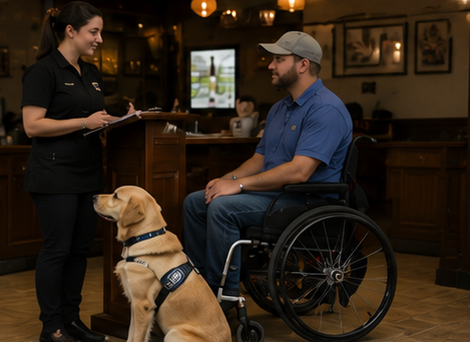
The Only 2 Questions a Business Can Legally Ask You Under the ADA
The Americans with Disabilities Act lets a restaurant, hotel, or store ask exactly two things — and prohibits...
Read →Get the card. Skip the explanations.
Digital handler ID + AI ADA Coach + state-specific rules from $4.99/mo. 30-day money-back guarantee on lifetime plans.
See plans →